
The Pivot to Basketball
Or, how I jumped from Our Team to Moses and the Doctor

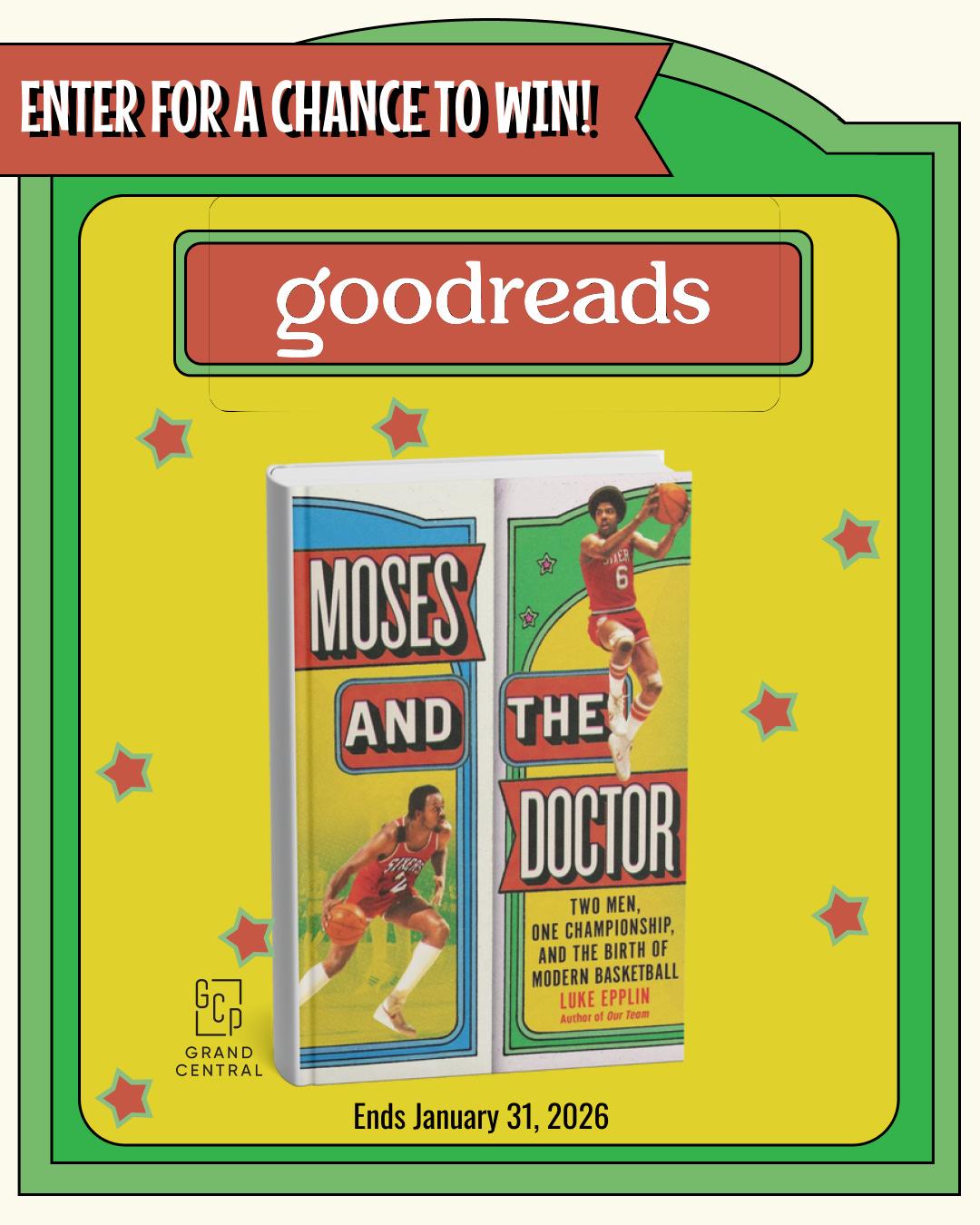
So here I am, months into this newsletter, and I’ve yet to do the thing that publishers expect of authors: aggressively promote their upcoming books. Mine is coming soon—five weeks from today, on February 10. Please excuse me as I start with a wee bit of publicity: Over the month of January, Goodreads is running a contest that will award thirty winners with a hardcover copy of Moses and the Doctor. All you need to do is visit this hyperlink and click on the “Enter Giveaway” button toward the top. Easy peasy.
OK, let’s begin with the obvious question: Why did I write a book on Julius “Dr. J” Erving, Moses Malone, and the 1983 Philadelphia 76ers? Full disclosure: I never saw Dr. J play (he retired before I started following sports), knew next to nothing about Moses, and had no connection to Philadelphia. What gives?
In truth, none of that bothered me. After all, the same could be said of Our Team: I wasn’t a Clevelander, recognized Larry Doby’s name but knew little about him, and had shallow knowledge of Bill Veeck, Bob Feller, and Satchel Paige. None of that was important to me. I stumbled upon the idea for the book while browsing through physical copies of The Sporting News from the 1940s at the New York Public Library. Right away I recognized that these four men—two white, two black—each represented a different facet of the integration experience that had just begun playing out across professional baseball. If I put them together and in tension with each other, I could tell an alternate story of integration, one that ran parallel to the Jackie Robinson/Branch Rickey narrative that has since become canon.
So I moved to Cleveland and started my research in earnest. Midway through, a realization struck me: This might very well be the greatest baseball story that I could’ve hoped for. It had everything: drama, fireworks, barnstorming, racial pioneers, war, tight pennant races, and several of the most colorful athletic figures this country has ever birthed. The pieces fit together so cleanly that at times it felt as if I were writing fiction.
There was just one problem: Deep down, I knew that I could search my entire life and never come across a better baseball story. So I didn’t try. Instead, I pivoted to my favorite sport: basketball.
But that didn’t mean that I put Our Team aside altogether. What I wanted was to find something analogous to the narrative thrust of Our Team—an era in in basketball history of change and invention, preferably one where multiple leagues and clashing styles of play had begun to scramble the look and feel of the sport. Immediately my mind flashed to the American Basketball Association, an upstart and colorful professional league whose lasting innovations include the three-point shot and the slam-dunk contest. But I didn’t want to tell the history of a league or an era. I’m interested in character above all. So if I were to make this into a book, I would need to find the right protagonists.
It all happened by accident. I was single at the time, hesitant about going on dating apps. (It’s hard for me to believe that I’ve been working on this book for longer than I’ve known my now-wife.) My literary agent had some experience with them. So we got together for drinks. He gave me some tips, we had some beers, and then the conversation shifted to writing. I told him that I was brainstorming a book on basketball. He asked what it was about. I said I didn’t know. We talked a bit about the sport, and out of nowhere I brought up Julius Erving. Walking back to the subway later on, I felt in my gut that Erving was who I was looking for. He was the epitome of 70s cool, someone who legitimized playground basketball in professional settings, a character outsized enough to carry a book.
I spent months reading all about him. I’m not a biographer and have little interest in becoming one. If I were to characterize myself, I’d say that I write narrative nonfiction, and I quickly realized that this narrative needed one more character, a counterweight of some sort. Little by little, I homed in on Moses Malone, the first player to skip directly from high school to the pros, a rebounding force whose game was as gritty as Erving’s was graceful. Through these two men, I recognized that I could tell not only the story of the ABA and its vast contributions to sport, but also an alternate history of basketball in the late 70s/early 80s, one centered not on Larry Bird’s Celtics and Magic Johnson’s Laker but on the clubs that they beat in the playoffs: Erving’s Philadelphia 76ers and Malone’s Houston Rockets. The climax, of course, would be when Erving and Malone teamed up on the 76ers to rampage through the league in 1983, disrupting the decade-long title swap between the Lakers and the Celtics.
I’d found my topic. Midway through writing the book, I started to wonder if I would ever find a better basketball story than this one. So I might be pivoting again. Back to baseball? To another sport? Away from sports altogether? Anything is possible. Just know that I’m searching once more.
I'll have to check out Moses and the Doctor. I'm a 76ers fan who started following them in 1980 as a kid, and was a huge fan of Dr. J (all-time favorite player) and Moses, and that 1982-83 team was amazing. And I loved both their journeys from the ABA to the NBA. 🏀