
Do You Write About Things Other Than Sports?
The inescapable, inevitable question

The thing about publishing a book is that you veer from locking yourself in silence for years to talking for days on end. It’s whiplash-inducing. Unless you’re some big-name personality, you’re obligated to accept every podcast request that comes your way. For months after your publication date, you’ll spend hours answering variations of the same questions. (How did you come up with your topic? What is your personal connection to the subject matter? How come your ten-word subtitle isn’t more nuanced? [Grrrrrr.])
The silver lining, beyond the publicity, is that in every interview, the host asks a question that you haven’t fielded before. Last week, I got a good one: “Do you ever get tired of writing books about sports?”
Now, there’s an unmistakable subtext to this question: Wouldn’t you rather write about something more important, something that matters, something beyond balls and points and championships?
In the brief period when I was on dating apps, I mentioned to various matches that I’d written a book about baseball, and they nodded and asked whether I write about things other than sports. That was an immediate red flag—if sports were too unserious or lowbrow for them, then we weren’t meant to be. (My wife, for the record, asked what my book was about—a green flag.)
A few months ago, at a book festival in Tucson, a renowned author lamented to me that they’d wasted their life writing about sports. This was someone with a handful of bestselling and critically acclaimed books to their name. If this individual couldn’t bask in their accomplishments, then what hope did the rest of us have?
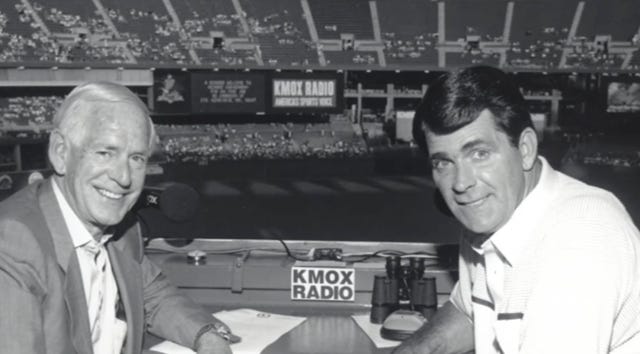
Thankfully, I don’t have these hangups. I was raised in a household in the rural Midwest where sports were a primary means of storytelling. My father, a diehard baseball fan and a pretty good player to boot, used to listen to St. Louis Cardinals games on the radio nearly every day during the summer. This was in the 1990s, when the Cardinals had fallen on hard times, so the outcome of the games meant little to me. What I enjoyed was listening to the two announcers, Jack Buck and Mike Shannon, fill the copious dead time during a baseball game with stories.
Buck and Shannon—their voices were the background noise of my childhood. I listened to them over dinner, in the car, outside and in. I remember thinking that Buck sounded the way he looked: silvery, smooth, and sober. Shannon, on the other hand, came across as someone parked at the end of a bar. He was passionate, incomprehensible at times, and sneakily insightful. A hometown hero who’d once shared the field with Bob Gibson, Lou Brock, and Orlando Cepeda came loaded with stories to tell, and Shannon unspooled them generously between batters, goaded on by Buck’s expert questioning.
There were no bookstores in my town. I’d never heard of The New Yorker or anything like that. Heck, I’d never even met a writer. What I had was Buck and Shannon, along with my dad’s baseball card collection, which I used to thumb through to learn about retired players from the 1950s and ’60s. I didn’t care about statistics or box scores or standings. I cared about narrative. I dreamed about being some version of Jack Buck—not an announcer (I’m too introverted for that) but a storyteller of sorts. It was only later, after I’d graduated college, that I picked up David Halberstam’s October 1964, a book about a championship Cardinals team that Mike Shannon had played on. The way that Halberstam strung together anecdotes and history while keeping his eye on the larger theme of race—that was what I wanted to do. I’ve never attempted to write about my beloved St. Louis Cardinals because Halberstam already wrote the exact book that I’d want to write.
Sports to me were never a stepping stone to something more meaningful or highbrow. As I learned from decades of basking in the broadcasts of Buck and Shannon, sports and storytelling go hand in hand, allowing for a perfect balance of history and drama, of the micro and the macro. So to get back to the original question: “Do I write about things other than sports?” Sure. They just happened to be contained within narratives about people playing games.
Totally relate to this. Growing up outside of Philly it was Harry Kalas and Whitey Ashburn for me.
Sports aren’t just “sports.” I think that’s why there are so many sayings in life that come from sport. It’s something we can all understand.