
Books Without Beat Writers
Or, the Death of Newspaper Sports Sections

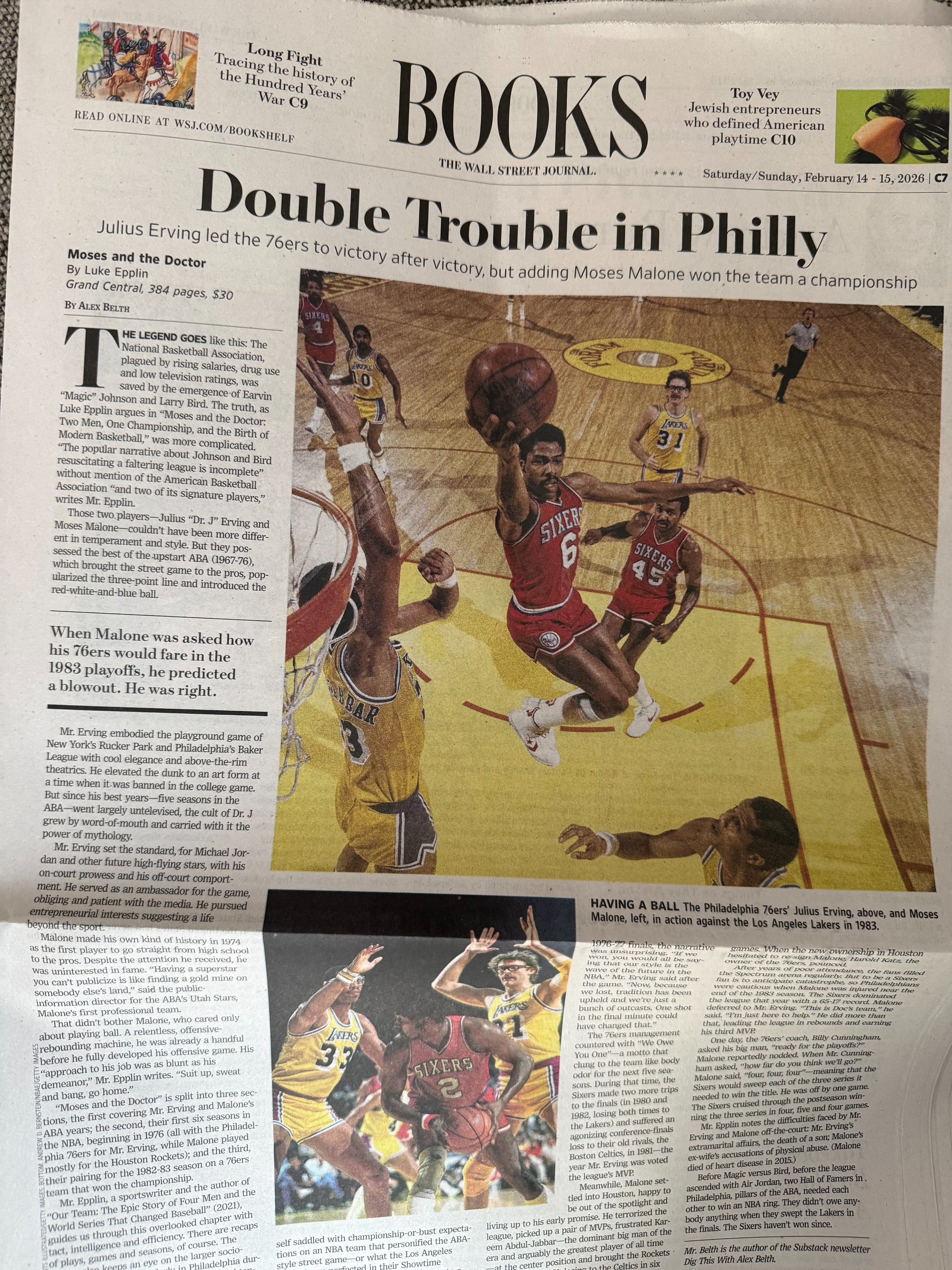
Last week, my new book, Moses and the Doctor, was the lead review in the Wall Street Journal’s weekend books section. This presented a dilemma: Where could I even purchase a physical copy of the WSJ in Jersey City?
On Saturday, while my daughter napped, I spent fifteen minutes wandering into bodegas and convenience stores, searching for newspapers. When I finally found a news rack, I was dismayed at how narrow and slight the WSJ felt in my fingers—much less substantial than I remembered a typical weekday edition of the St. Louis Post-Dispatch feeling during my childhood. I flipped through the pages, making sure that sections weren’t missing.
And that’s when it hit me: It’d been years since I’d purchased a physical copy of a newspaper. Heck, I no longer read physical copies of magazines. Sure, I still subscribe to numerous publications—The New York Times, The New Yorker, The Atlantic, New York Magazine, etc.—but I browse them all digitally. The change happened gradually and then suddenly. When I first moved to New York City, I often splurged on the Sunday edition of the Times, whose pages and crossword puzzle could occupy me for days. Every week I devoured The New Yorker on the subway. On Tuesday nights, I snapped up the Village Voice, which pointed me to the free weekend cultural events that underpaid publishing professionals like me thrived on.
Over the next two decades, the Village Voice folded; social media ramped up. By the time I started researching Our Team, I no longer had time to luxuriate in print. I scrolled through websites over coffee, then locked my internet so that I wouldn’t be tempted to mess around online during writing hours. I was under contract at a publishing house for a book, the ultimate print product, while I was simultaneously shedding paper for pixels everywhere else.
Why does this matter? Two weeks ago, The Washington Post shuttered its sports section. This wasn’t just any sports section. It was a place that had nurtured some of the most renowned sportswriters in the country: Shirley Povich, Jane Leavy, Tony Kornheiser, John Feinstein, Sally Jenkins, Michael Wilbon, Thomas Boswell, and David Aldridge, among many others. The Washington Post without a sports section was harder to imagine than The Washington Post without Bob Woodward.
For both of my books, I dove deep into The Washington Post archives. Shirley Povich wrote extensively on integration in Cleveland, in thoughtful and revealing ways, many lines of which made their way into Our Team. Jane Leavy penned a lively portrait of Julius Erving in the early 1980s while Tony Kornheiser wrote about Moses Malone, perhaps the most difficult basketball superstar ever to cover, better than anyone around. No matter your subject matter, the Post archives are essential reading.
At their best, sports sections at newspapers served as running diaries across seasons. The beat writers traveled with local teams, got to know the players, analyzed the games, provided behind-the-scenes fodder, and painted daily portraits of athletes in motion, whether on or off the court. There’s no way I could’ve pieced together narratives of the 1948 Cleveland Indians or the 1983 Philadelphia 76ers without those first drafts of history.
The challenge I had with my new book, Moses and the Doctor, was in dramatizing a season in which the Philadelphia 76ers romped to the title with business-like efficiency. How could I make dominance interesting?
The answer, I learned, was in finding small details that allowed me to remain in scene as much as possible. For example, during a writeup of a game against the Cleveland Cavaliers on January 19, 1983, George Shirk, a beat writer for the Philadelphia Inquirer, included a paragraph about the Sixers players trudging through the snow outside their Ohio hotel at five in the morning, en route to a sunrise flight back to Philadelphia. It was a throwaway paragraph, an aside that Shirk used to talk about the grueling game that those same sleep-deprived players had endured not even six hours earlier.
But for me, it was everything. I couldn’t have asked for a better still-life of midseason malaise—the weary players waking before the dawn, their limbs caked in ice, braced to ascend into blizzard-like conditions on a cramped commercial flight, trying to cobble together enough sleep to carry them through their fourth game in six nights. I opened a chapter with that image, which gave me an entryway into how the 1983 Sixers team overcame the mundane injuries and perpetual fatigue that underscore the reality of professional basketball in the dead of winter.
If we’re moving past the age when daily newspapers supported sportswriting at its finest, then what will take its place? Will writers decades from now be able to piece together enough material from the tweets and videoclips that circulate on social media? Or will the more intimate details that only a beat writer on deadline could have access to be lost, leaving no more of an impression than a February snowprint in Cleveland?
I’m often asked if I’d ever write a book set in the present. The answer is no, not because I don’t admire contemporary athletes, but because it wouldn’t be nearly as pleasurable. Even if I’m now part of the problem, as someone who’s cut physical media out of his existence, I enjoy nothing more than revisiting eras when you could read the day-by-day newspaper beat of a long season as if it were a novel.
This is my new reality as well. All of the publications I read and subscribe to are digital. Is started slowly and now it's a staple.
It's funny how those little scenes journalists used to throw in are so compelling in retrospect. I have a similar reaction when I see them: "there it is; that's it." A lot of sports journalism consists of records, but those vignettes are the portals.